
Test strategy and risk mapping
Critical journeys, data setup needs, and the right layer for each check.
Build test strategy, automation, and performance evidence into the release path so quality is measurable before customers or operations feel the failure.
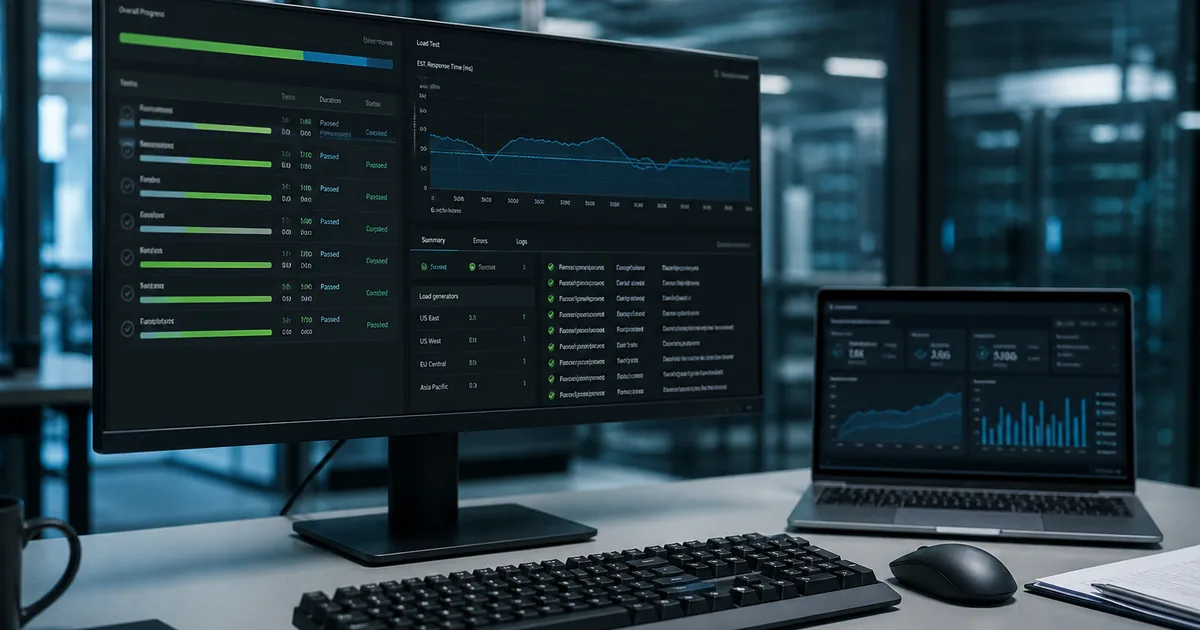
QA automation and performance testing make product risk visible before release: which paths are covered, which checks gate a deploy, and how the system behaves under load. One Team US builds test strategy, automation suites, and performance scenarios that fit your architecture and delivery cadence.
Testing is not theater. Coverage should map to business risk—payments, permissions, integrations, and the journeys customers repeat daily.
| Current condition | Quality response | Result |
|---|---|---|
| Releases depend on tribal manual checks | Risk-based automation | Repeatable evidence each build |
| Bugs escape to production regularly | Layered API/UI tests in CI | Defects caught earlier |
| Performance is unknown until launch week | Load scenarios with budgets | Capacity conversations use data |
| Integrations break silently | Contract and end-to-end checks | Interface drift is detected |
| Regressions follow every refactor | Smoke and critical-path suites | Refactors stay safer |
| No shared definition of “done” | Quality gates in the pipeline | Teams release against the same bar |
Critical journeys, data setup needs, and the right layer for each check.
Fast, stable tests for business rules and integrations.
Focused browser/mobile checks where UI risk is real—not brittle suites for every pixel.
Scenarios for peak usage, soak behavior, and regressing latency/error budgets.
Automated suites that run on pull requests and release candidates with clear pass/fail.
Approaches for seeding, isolation, and privacy-safe fixtures.
Quality engineering connects risk to automated checks and release evidence—not a last-minute manual pass.
Quality engineering connects risk to automated checks, CI gates, and release evidence.
1. Identify the journeys and integrations where failure is costly. 2. Choose layers (unit, API, UI, performance) that match risk and stability. 3. Automate the critical path first; expand with evidence of ROI. 4. Wire suites into CI with deterministic data setup. 5. Add performance budgets where latency or concurrency matters. 6. Maintain tests as product code with owners and triage rules.
Production data is not a casual test fixture. We prefer synthetic or anonymized data, secret-safe configs, and environments that mirror production topology without exposing customer information.
Tenant-aware regression suites and performance checks before plan-wide rollout.
Permission, audit, and integration paths tested on every release candidate.
Checkout, search, and peak-traffic scenarios.
Critical mobile journeys plus API contract coverage.
Heightened attention to access control, audit trails, and release evidence.
A critical-path automation suite can often be established in a short engagement once environments and access exist. Mature quality programs grow iteratively as the product grows. Performance testing requires representative environments and realistic data shapes.
Brittle tests erode trust in the suite.
Percentages without risk mapping create false comfort.
One pre-launch trial does not protect against later regressions.
Red builds that everyone ignores are not gates.
They establish strategy, automated tests, performance scenarios, and CI gates that provide release evidence.
No. Automation handles repeatable checks; exploratory and usability judgment remain human strengths.
Fast, deterministic API and smoke checks on every PR; broader UI and performance suites on a defined cadence or release candidate.
Yes. Contract tests and controlled end-to-end paths are often the highest-ROI automation for enterprise systems.
Stable selectors, API-layer preference, isolated data, retries only with cause, and quarantine policies.
As soon as a realistic path exists—ideally before marketing drives peak traffic, and continuously thereafter for critical APIs.
Yes. We align with your stack where it is sound and recommend changes only when the tool blocks the quality signal.
List the top customer journeys and recent production defects. We map risk to a first automation and performance slice.
One Team US can establish the test layers, automation suite, and performance checks your product or enterprise application needs before each release.