
CI/CD pipelines
Build, test, security checks, and deploy paths for the applications you run.
Operate enterprise applications with CI/CD, monitoring, incident response, and support practices that keep releases controlled after launch—not only during the initial build.
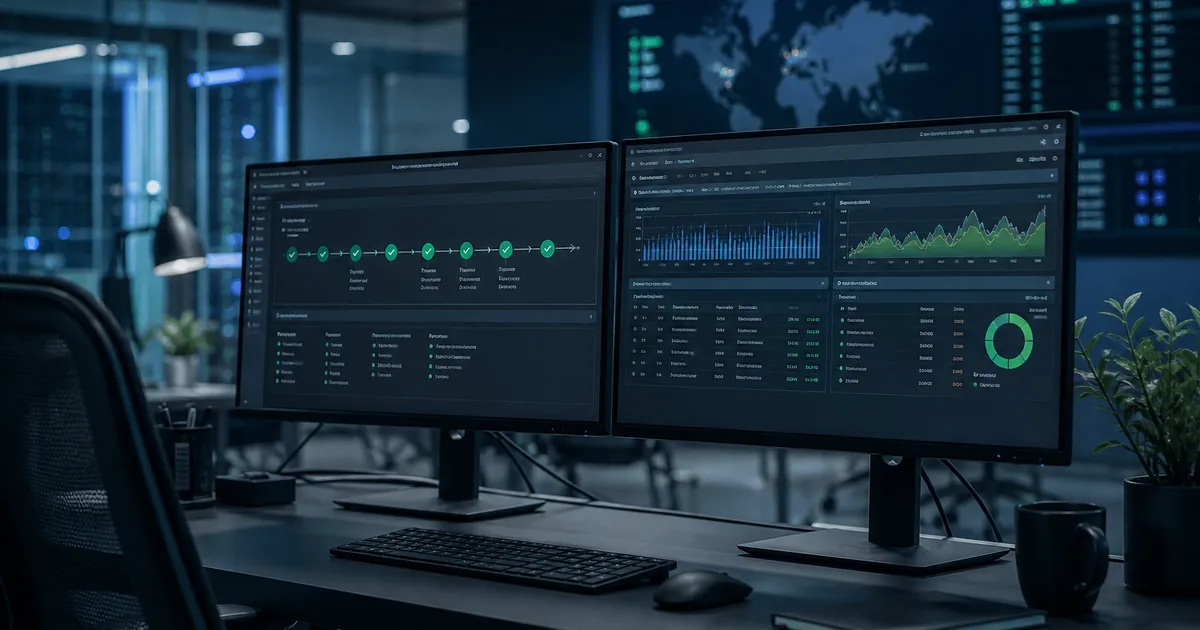
Application support and DevOps implementation give enterprise and SaaS software a controlled life after go-live: CI/CD, environments, observability, incident response, and a support backlog with owners. One Team US builds the operating path so releases stay small, failures are visible, and improvements do not require heroics.
This complements development. Without it, even good software decays under manual deploys, unread alerts, and unclear ownership.
| Current condition | Operating need | Result |
|---|---|---|
| Deployments are manual and stressful | CI/CD with promotion gates | Predictable releases |
| Nobody knows when APIs degrade | Metrics, logs, traces, alerts | Faster detection |
| Production fixes bypass review | Change process with evidence | Lower change failure rate |
| Support requests live in email | Ticketed backlog with SLAs | Visible priorities |
| Staging does not match production | Environment parity practices | Safer validation |
| Only one engineer can release | Documented pipelines and backups | Reduced bus factor |
Build, test, security checks, and deploy paths for the applications you run.
Dev/stage/prod (and more if needed) with controlled configuration and secrets.
Dashboards and alerts tied to user journeys and SLOs—not only host CPU.
Severity definitions, on-call expectations, post-incident learning, and release notes.
Triage, bug/fix prioritization, and communication paths for stakeholders.
Infrastructure as code where appropriate, dependency updates, and backup/restore drills.
Support and DevOps close the loop from code change to production health and a clear owner for every incident.
Support and DevOps close the loop from code change to production health and clear ownership.
1. Assess current release, monitoring, and support pain. 2. Stabilize the delivery pipeline for the main application path. 3. Add observability that matches real user journeys. 4. Define support intake, severities, and response expectations. 5. Improve iteratively with measurable operating metrics.
Secrets management, least-privilege deploy identities, audited production access, dependency scanning in CI, and separation of duties where the risk profile requires it. Support access to production data is controlled and logged.
Tenant-aware alerting, release trains, and support workflows.
Uptime-sensitive operational apps with clear incident paths.
Heightened access control, auditability, and change discipline.
Channel-specific monitoring and staged mobile/backend releases.
Pipeline and baseline monitoring improvements can often land in a short engagement. Deeper reliability work—SLOs, on-call maturity, environment parity—arrives in phases. Support models can start with business-hours coverage and expand as needed.
A dashboard nobody trusts does not improve reliability.
Pages that always fire teach teams to ignore signals.
Bugs pile up with no path into engineering planning.
Operating models need continuous attention as the product changes.
They implement the pipelines, environments, monitoring, and support practices required to run software safely after launch.
Engagements can include implementation only, shared operations, or defined support coverage under agreement terms.
Yes, with least-privilege access and clear boundaries.
Migration moves workloads. Support and DevOps make ongoing change and reliability operable. Many programs need both.
Yes. We assess the codebase and runtime, then stabilize the operating path before larger feature work.
No. We prefer to strengthen what you have when it is sound.
Severity definitions, communication expectations, remediation, and a short learning record so repeats are less likely.
Share how you deploy today, where incidents hide, and what “support” means to your stakeholders. We propose a stabilization sequence.
One Team US can implement the pipelines, observability, and support model your application needs so changes stay safe and ownership stays clear.