
ERP and financial systems
Including Odoo and other ERPs where order, inventory, and accounting must remain authoritative.
Connect ERP, CRM, cloud, and custom applications with governed APIs, data contracts, and reliable workflows so teams stop reconciling the same work in multiple systems.
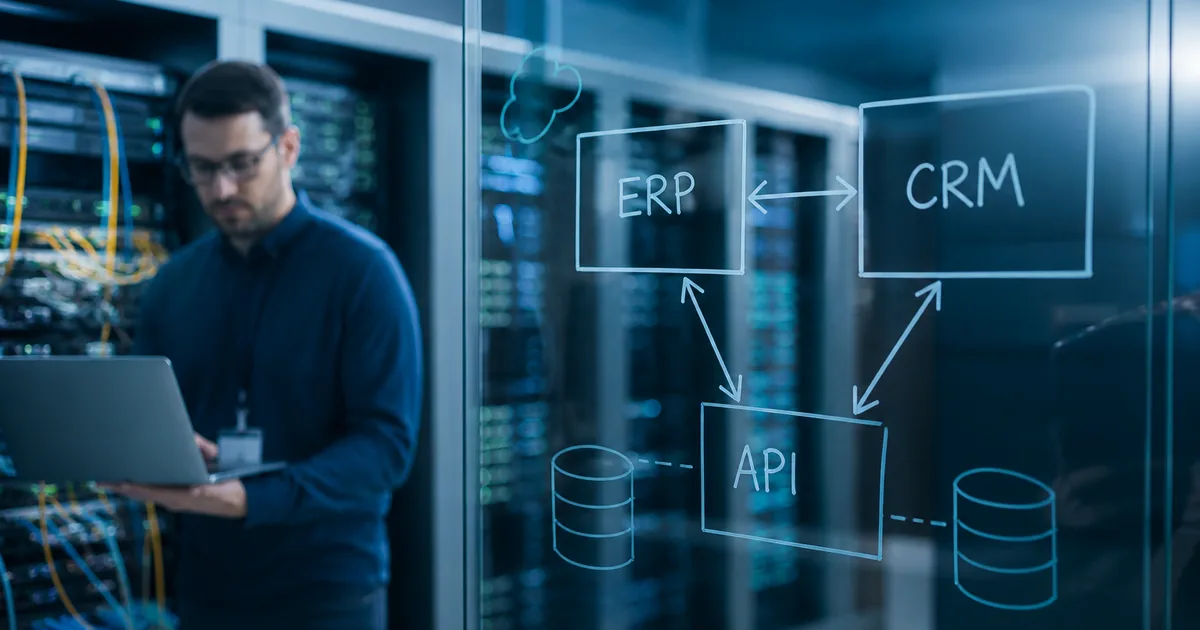
Enterprise system integration connects ERP, CRM, cloud platforms, files, and custom applications so a business process can complete without duplicate entry or silent drift. One Team US designs API, event, and orchestration patterns with contracts, validation, retries, and audit trails.
This is broader than a single vendor connector. The work is the operating path between systems: what moves, when, under whose identity, and what happens when a message fails.
| Current condition | Integration pattern | Result |
|---|---|---|
| Staff copy data between ERP and CRM | Bidirectional or mediated sync with conflict rules | Consistent customer and order state |
| Nightly files arrive late or incomplete | Validated file/API ingestion with quarantine | Bad data does not silently load |
| Point-to-point scripts are brittle | Gateway and reusable contracts | Changes are localized |
| Cloud apps sit outside the ERP process | Orchestrated workflows with write-back controls | Cloud tools participate without bypassing finance rules |
| No one can explain a failed update | Correlation IDs, retries, and audit | Failures are diagnosable |
| Partners need selective data access | API products with auth and scopes | External access stays governed |
Including Odoo and other ERPs where order, inventory, and accounting must remain authoritative.
Salesforce, Dynamics, HubSpot, and custom CRM paths tied to real fulfillment or service status.
Controlled connections that respect identity, rate limits, and data minimization.
Domain services that publish and consume events or APIs without embedding vendor SDKs everywhere.
Where partners still require files, with schema checks and operational visibility.
Service accounts, least privilege, and customer/partner API credentials managed as production assets.
Integration should preserve system authority: each write-back follows contracts, identity, retries, and an audit trail teams can trust.
Integration preserves system authority through contracts, orchestration, validation, and audit.
1. Inventory systems, owners, and the workflow that needs continuity. 2. Define canonical events/data contracts and conflict rules. 3. Implement a thin vertical integration for one high-value path. 4. Add monitoring, retries, replay, and runbooks. 5. Expand coverage once the first path is operationally stable.
Credentials are stored in managed secrets. Scopes are least-privilege. Personal and financial data are minimized in transit. Logs retain enough to audit without becoming an unmanaged data lake. Changes to mappings are versioned like application code.
Item, inventory, and order synchronization between ERP, portals, and shop-floor or dealer tools.
Scheduling, CRM, and operational systems connected without inventing a second clinical record.
Job, estimate, and payment status flowing among mobile apps, CRM, and accounting.
Shipment events shared with customer portals, TMS, and notification systems.
Catalog, inventory, and order updates across ecommerce, ERP, and warehouse tools.
A single critical path can often be productionized in a short phase once APIs and owners are clear. Broader landscapes take longer because each system adds contracts, test data, and failure modes. Timeline follows interface reality, not slideware.
Every new app adds another fragile script.
Two writers without rules create permanent reconciliation work.
Happy-path demos hide poison messages, partial updates, and retries that double-post.
Business fields change; mappings need ownership and tests.
They connect business systems through APIs, events, files, and orchestration with contracts, security, monitoring, and operational ownership.
Tools help. Architecture decides contracts, identity, error handling, and which system remains authoritative.
Yes. Odoo and other ERPs are common hubs; the design keeps financial and inventory authority clear.
Yes. Cadence follows the workflow. Some paths need events; others are correctly batch with validation.
Contract tests, synthetic transactions, staging end-to-end runs, and monitored pilots before broad cutover.
We assess adapters, controlled database interfaces, RPA as a last resort, or a strangler path that exposes an API layer.
Encrypted channels, scoped credentials, minimized payloads, and audited write-backs.
Pick one painful handoff between systems. We map owners, contracts, and failure modes, then implement that path as a reusable pattern.
One Team US can map your systems, define integration contracts, and implement the orchestration path your workflows actually need.